
10 Signs of an Emotionally Immature Woman and How to Respond

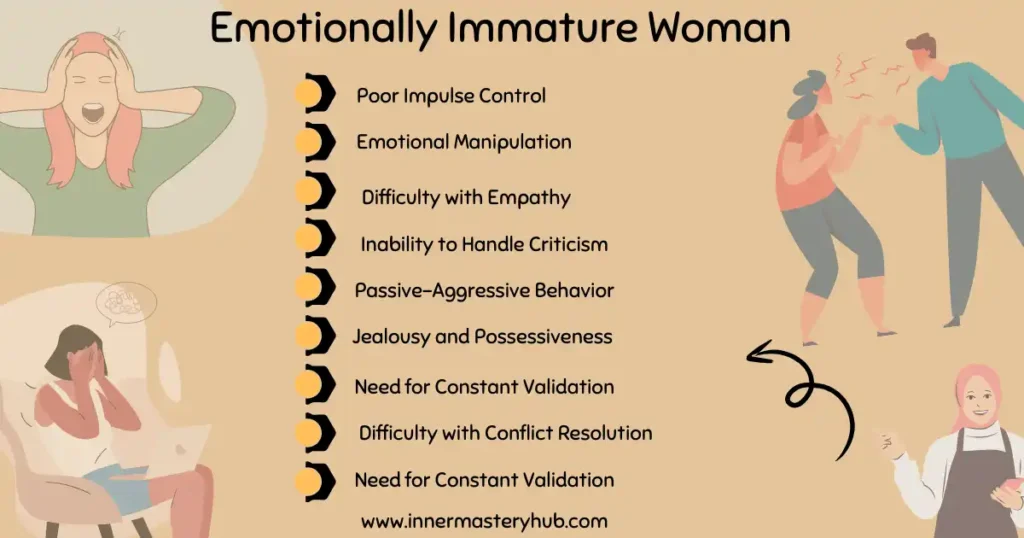
An emotionally immature woman struggles with emotional regulation, reacting to perceived rejection or criticism through defensiveness and withdrawal. Psychological research shows these reactions usually stem from undeveloped emotional coping skills rather than intentional behavior.
Emotionally Mature vs Emotionally Immature Responses
| Emotionally mature response | Emotionally immature response |
|---|---|
| Accepts reasonable feedback | Becomes highly defensive |
| Regulates strong emotions | Reacts impulsively |
| Takes responsibility | Frequently shifts blame |
| Communicates directly | Withdraws, attacks, or avoids |
| Tolerates disagreement | Treats disagreement as rejection |
| Considers other perspectives | Struggles to see beyond own feelings |
| Respects boundaries | May react strongly to boundaries |
| Reflects after conflict | Repeats the same conflict pattern |
Sometimes a normal disagreement suddenly turns into emotional chaos. You try to explain, but the conversation always repeats the same pattern. Emotional intensity feels real because the issue itself seems small.
This experience is linked to an emotionally immature woman. Many people believe it means someone is childish, but in reality, it is a psychological term.
Emotional immaturity in adults is the issue of poor emotional regulation. Emotional regulation is the ability to process and respond to emotions in a balanced way. When this ability is underdeveloped, emotions become difficult to manage. Your mind misreads ordinary situations as personal threats, which trigger your defensive reactions.
This creates a pattern inside:
trigger → interpretation → emotional reaction → relational consequence
A minor argument turns into a perceived rejection. That interpretation fuels anxiety. The connection is then harmed by the response, which raises the internal anxiety.
You’ll observe this behavior differently if you understand its pattern. Rather than posing the query, “Why is she acting like this?” the true inquiry is: “What emotional process inside her leads to these reactions?”
It is also important to distinguish between personality traits, such as introversion, and emotional regulation patterns. Not all emotional withdrawal is immaturity; sometimes it reflects temperament and internal processing styles.
Who Is an Emotionally Immature Woman?
Emotional immaturity in women is not an isolated trait. It is connected to emotional regulation patterns, nervous system responses, and early childhood emotional experiences that shape how a person handles stress and relationships later in life.
A woman who struggles with processing emotions, taking ownership of her feelings, and handling conflict in a composed manner is considered emotionally immature. Your ability to think critically is being overwhelmed by emotions, leading to defensiveness and rash decisions.
A limited capacity to control emotions, withstand discomfort, and react rationally rather than impulsively is referred to as emotional immaturity.
When these abilities are lacking, your thinking is dominated by your emotions. Research indicates that relationship stability and psychological well-being are significantly affected by emotional management abilities1.
Emotional Immaturity vs Emotional Dysregulation
| Emotional immaturity | Emotional dysregulation |
|---|---|
| Broad pattern involving accountability, empathy, communication and coping | Difficulty managing the intensity or duration of emotions |
| May affect conflict and relationships | Can occur across many psychological conditions or situations |
| May include blame-shifting or avoidance | Does not automatically involve blaming others |
| Informal descriptive term | Established psychological concept |
| Not a diagnosis | Not necessarily a diagnosis itself |
10 Signs of an Emotionally Immature Woman
1. Difficulty Regulating Emotional Reactions
When a woman experiences criticism, disappointment, or rejection, she may find it difficult to control her emotions. Strong emotions can quickly take over, resulting in defensive behavior, rash remarks, or responses that seem more significant than the actual circumstance.
What it looks like
An emotional reaction, such as snapping, shutting down, saying something unpleasant, or assuming the worst right away, can result from a minor argument or criticism.
How to respond
Refrain from making snap decisions. After your emotions have subsided, take a brief break, calm down the talk, and bring up the topic again. “I want to talk about that; let’s come back to where we’re both calmer”, you might say. Recognizing the emotion without allowing it to dictate the entire reaction is a sign of healthy emotional regulation.
2. Difficulty Handling Conflict
It can be difficult to deal with an emotionally immature individual, particularly when conflict comes up. Think back to a time when you attempted to have a private conversation with a friend about a misunderstanding.
Instead of listening, she shut down and started accusing you, turning the entire situation into a blame game.
What it looks like
When you politely bring up a misunderstanding, she either withdraws, stops listening, or reacts by making charges that divert attention from the initial problem.
How to respond
Maintain a composed tone and concentrate on one problem at a time. “I want to understand your side, but I also need us to talk about what happened without blaming each other,” you may add. If the discussion gets tense, don’t force a resolution right away; instead, take a break and come back to it later.
3. Unrealistic Relationship Expectations
Remember when you planned a romantic weekend getaway with your significant other? They spent much of their time on their phones, contrary to your expectations of romantic dinners and beach walks. Oh no! Deep frustration might result from unrealistic expectations.
What it looks like
You arrange a weekend together, but it doesn’t go quite as she had hoped. She feels angry and views the whole experience as a failure rather than expressing her disappointment.
How to respond
Instead of mind-reading, promote transparent communication. “Tell me what you were hoping for so we can talk about what is realistic for both of us,” you may say. Flexibility, open communication, and acceptance that another person can’t always live up to expectations are all necessary for healthy relationships.
4. Jealousy and Possessiveness
You might overreact to harmless chats in a romantic relationship by constantly checking your phone or becoming overly suspicious, especially if the woman is emotionally immature. The idea of someone else having your attention is too much for them to handle.
What it looks like
Even in situations where there is no obvious indication of betrayal, a casual chat with someone else can result in persistent interrogation, accusations, behavior checks, or requests for assurance.
How to respond
Recognize genuine concerns without constantly demonstrating your allegiance or tolerating domineering behavior. “I’m willing to talk about what is making you feel insecure, but I’m not comfortable with accusations or having my interactions controlled,” you might add. Honest communication, sensible boundaries, and respect for one another all contribute to the development of trust.
5. Passive-Aggressive Communication
An emotionally immature woman may convey anger, disappointment, or resentment indirectly rather than directly. Sarcasm, silent treatment, backhanded remarks, purposeful disengagement, or saying “I’m fine” while obviously acting as tho something is wrong are some examples of this.
What it looks like
She stops responding normally, makes snarky comments, or expects you to understand why she is upset after a fight, even tho she maintains nothing is wrong.
How to respond: Don’t speculate or keep looking for an explanation. Saying something like, “I can tell something is bothering you” encourages straightforward communication. When you’re prepared to tell me exactly what’s wrong, I’m willing to discuss it. You can respect her emotions while establishing limits on rude or indirect communication.
6. Difficulty Showing Empathy
Putting oneself in others’ shoes is difficult. But it might be almost impossible for an immature and emotionally detached lady. Others find it difficult to relate to others’ feelings as a result.
She might say offensive things or completely ignore others’ emotions. She appears to be experiencing emotions in a new way.
What it looks like
You tell her that something she said hurt you, but instead of acknowledging your feelings, she immediately shifts the conversation to how the situation affected her.
How to respond
Explain the impact clearly without attacking her character. You might say, Youu don’t have to agree with my reaction, but I need you to understand that this hurt me. Listen to her perspective as well, but remember that empathy should be mutual. You do not have to dismiss your own feelings to accommodate hers repeatedly.

7. Constant Need for Validation
A woman who lacks emotional maturity may constantly seek admiration, praise, and recognition.
Don’t give her lots of praise; she can become insecure. She might also become upset if her social media doesn’t get enough attention. She seems to rely on others’ opinions to determine her own value.
What it looks like
She can constantly seek affirmation, become angry when she doesn’t get enough attention, or base her sense of value on praise and social acceptance on social media.
How to respond
Offer reassurance when it is genuine, but avoid becoming responsible for maintaining her self-esteem. You might say, “I care about you, but I can’t constantly prove your worth for you.” Encourage self-confidence, independence, and support that does not depend entirely on outside approval.
8. Strong Sensitivity to Criticism
Due to inadequate emotional development during childhood, an emotionally immature woman may find it difficult to take constructive criticism.
Even the most basic suggestions can come across as personal to her. She shuts down, becomes defensive, or has a little tantrum instead of seeing them as chances to improve.
What it looks like
When you make a sensible proposal, she reacts by shutting down, arguing, or assuming you are criticizing her personally rather than focusing on a particular behavior.
How to respond
Feedback should be calm, precise, behavior-focused: I’m not criticizing you; I’m discussing a single issue that affected me. If defensiveness escalates, stop the discussion and resume it when both parties can listen more honestly.
9. Difficulty Taking Responsibility
When confessing a mistake is intimidating or uncomfortable, an emotionally immature woman may find it difficult to admit her role in an issue. Rather, she might place the blame on external factors, concentrate on your mistakes, offer justifications, or divert attention from her own actions.
What it looks like
When you tell her that anything she did upset you, she says, “I only did that because of how you treated me,” rather than confronting the issue.
How to respond
Instead of debating who is the worst person, keep the discussion on the particular behavior. “We can talk about my part too, but right now I’d like us to address what happened here,” you might remark. Acknowledging your own behavior without placing blame on others is a sign of healthy accountability.
10. Manipulation or Blame-Shifting During Conflict
To avoid discomfort or recover control of the situation, an emotionally immature woman may utilize victim language, withdrawal, guilt, blame, or threats. Sometimes this is intentional, but other times it might be the result of anxiety, inadequate coping mechanisms, or emotional exhaustion rather than a deliberate manipulation strategy.
What it looks like
She might give the silent treatment, use guilt to get what she wants, threaten to leave during disputes, or play the victim when you voice concerns. As a result, you start concentrating on soothing her rather than fixing the initial problem.
How to respond
Keep your attention on the particular behavior and refrain from debating motivation. “I’m willing to talk about this, but I’m not comfortable with threats, guilt, or blame being used to end the conversation,” you might add. Establish unambiguous boundaries and focus on recurring trends rather than a single emotional event.
What Causes Emotionally Immature Reactions to Happen?
Emotionally immature reactions occur when a person interprets situations through the lens of fear, insecurity, or unresolved emotional patterns. The brain reacts defensively before rational thinking engages.
Emotional reactions usually follow a pattern.
- Trigger – a disagreement, criticism, or unmet expectation
- Interpretation – the mind reads the situation as rejection or threat
- Emotion – anxiety, anger, shame, or fear appears
- Reaction – blame, shutdown, or emotional outburst
This cycle happens quickly, without conscious awareness. Stress and perceived threat can influence attention, emotional processing, and cognitive control, making reflective responses more difficult in emotionally intense situations2.
What Can Contribute to Emotional Immaturity?
Rather than having a single cause, emotional immaturity typically results from a confluence of relational patterns, coping mechanisms, life events, and emotional abilities. Some people were never taught how to control their intense emotions, express their needs clearly and concisely, or accept responsibility when faced with conflict.
Among the potential contributory elements are:
- Limited emotional learning during childhood: An individual may not have acquired the skills necessary to identify emotions, relax, resolve conflicts, or express needs directly.
- Emotional neglect: It might be more difficult to comprehend, communicate, or react to emotions in later life if one does not receive regular emotional care as a child.
- Chronic stress: Persistent stress can make emotional reactions feel more intense or harder to control, and can impair patience.
- Insecure attachment: Reassurance-seeking, withdrawal, defensiveness, or trouble trusting people can all be caused by a fear of rejection, abandonment, or intimacy.
- Inability to control emotions: When feelings go out of control, a person may act impulsively, shut down, place the blame elsewhere, or steer clear of challenging talks.
- Learned familial communication patterns: Individuals may replicate actions they frequently saw as children, such as avoiding disagreement, shouting, blame-shifting, or quiet treatment.
- Trauma in some situations: Trauma does not always result in emotional immaturity, although it can affect stress reactions, trust, emotional regulation, and relationship behavior.
According to research, insecure attachment, negative childhood experiences, and emotional maltreatment throughout childhood may be linked to problems regulating emotions later in life. Although the authors of a 2024 scoping review identified many gaps in the literature, they also discovered evidence linking adult emotion-regulation issues to childhood neglect. Similar correlations between negative childhood experiences, insecure attachment, and trouble controlling emotions have been discovered in more recent reviews2.
No one will necessarily become emotionally immature as a result of these conditions, which can influence people of either gender. The most crucial question is whether the individual is aware of unhealthy habits and is prepared to learn better techniques for handling relationships and emotions.
Emotional Immaturity vs Personality Disorder
Personality problems and emotional immaturity are two different things. An informal term describing persistent issues with emotional control, responsibility, empathy, communication, or conflict resolution. It is not a diagnosis related to mental health.
On the other hand, a personality disorder is a recognized mental health illness that involves recurring thought, feeling, and behavior patterns that have a substantial impact on relationships, day-to-day functioning, or overall wellbeing. A thorough evaluation by a mental health practitioner is necessary for diagnosis.
| Emotional Immaturity | Personality Disorder |
|---|---|
| Informal descriptive term | Recognized mental-health diagnosis |
| May involve poor emotional regulation | Involves broader, persistent patterns of functioning |
| May appear more strongly in certain situations | Patterns generally occur across multiple areas of life |
| Can include defensiveness, blame, or avoidance | Symptoms depend on the specific disorder |
| Does not automatically indicate mental illness | Requires specific diagnostic criteria |
| Cannot be diagnosed from a list of signs | Requires professional assessment |
Can They Look Similar?
Occasionally. There are a variety of causes for behaviors such as strong emotional responses, marital problems, impulsivity, sensitivity to rejection, or difficulties accepting responsibility. Observing these behaviors does not indicate that a person has a narcissistic, borderline, or other personality disorder.
The crucial distinction is that behaviors that appear similar do not necessarily indicate the same underlying cause or diagnosis. Before making a diagnosis, a professional takes into account the patient’s functioning, history, symptom intensity and duration, and general behavioral pattern.
Can Emotional Immaturity Change?
Yes, emotional immaturity can change. Emotional skills are not fixed, and people can learn healthy ways to manage their behaviors over time. Growth usually begins when a person becomes aware of their emotional patterns and takes responsibility for them.
Change does not happen overnight. It requires self-reflection, self-awareness, life experience, and supportive relationships. With consistent effort, many emotionally immature people can develop more self-awareness and emotional control.
How do I know if I am emotionally immature?
You might be emotionally immature if you struggle to manage your feelings, blame others, avoid responsibility, overreact to criticism, have difficulty communicating honestly, seek constant validation, or repeat unhealthy patterns instead of reflecting, learning, and growing from your experiences.
What Common Mistakes People Make When Dealing With Emotional Immaturity
People try to fix behavior through logic, criticism, or control. But emotional reactions rarely respond to logic alone.
1. Over-explaining logically
Logic does not calm emotional overwhelm.
2. Taking reactions personally
Emotional reactions usually reflect internal insecurity.
3. Trying to win arguments
This increases defensiveness.
When to Step Back or Seek Support
When emotional immaturity consistently leaves you feeling guilty, worn out, confused, or responsible for handling others’ feelings, it might be time to take a step back.
Stronger boundaries or expert assistance should be considered if:
Your boundaries are consistently disregarded; the same damaging disputes persist; guilt, threats, blame, or silent treatment are frequent; you conceal your needs to prevent their reactions; and the relationship negatively impacts your emotional health.
Someone cannot be made to change by force. Prioritize maintaining healthy boundaries, communicating clearly, and safeguarding your wellbeing.
Conclusion
The term “emotionally immature” sounds critical. However, there is typically a deeper emotional problem hidden underneath the label. Rarely does emotional immaturity stem from intent. Unprocessed emotional events, insecurity, or a lack of emotional intelligence are common causes.
Feelings become overwhelming when you are unable to control your emotions. The mind responds rapidly before grasping the situation. Understanding the emotional process changes our perception of these actions.
Instead of asking, “Why is she so difficult?”
“What emotional interpretation is happening inside he?”
Deeper empathy, better relationships, and emotional development are all made possible by this change of perspective.
Key Takeaways
- Emotional immaturity is about emotional regulation.
- It often develops from childhood experiences.
- Common signs include defensiveness, blame, and validation-seeking.
- Growth is possible through self-awareness and therapy.
Disclaimer
Emotionally immature women is an informal description, not a psychological diagnosis. Emotional immaturity can occur in people of any gender and generally refers to recurring difficulties with emotional regulation, accountability, empathy, communication, and handling conflict. One reaction alone does not make someone emotionally immature; patterns over time matter more.
People Also Ask
What are the signs of an emotionally immature woman?
Women who lack emotional maturity may find it difficult to take responsibility, overreact to criticism, require constant affirmation, or steer clear of awkward conversations. They could place excessive emphasis on their demands, show no empathy, or act carelessly, all of which make partnerships challenging. Recognizing these personality qualities will aid in finding positive solutions to issues.
Can an emotionally immature woman change?
Growth can be encouraged by self-reflection, therapy, and supportive relationships. But for her to undergo metamorphosis, she must be prepared to acknowledge her issues and work on controlling her emotions, which may need time and consistent effort.
Is emotional immaturity a personality disorder?
Emotional immaturity is not a personality disorder. Some behaviors discussed in everyday descriptions of emotional immaturity can also occur in people with mental-health conditions, but similar behaviors do not establish a diagnosis. Personality disorders require assessment by a qualified mental-health professional based on a much broader pattern of symptoms and functioning.
How to communicate with an emotionally immature woman?
Make use of direct, composed, and non-aggressive words. Please avoid criticism that makes you defensive. Set boundaries, affirm feelings, and actively listen. Encourage candid communicationDon’t’t push for change. She might feel more at ease expressing herselfDon’t’t respond emotionally; be patient and consistent.
What are the biggest signs of an emotionally immature woman?
Difficulty accepting responsibility, intense emotional responses to minor problems, rapid blame-shifting, and a tendency to evade accountability are common symptoms. She might exhibit mood swings, struggle with self-awareness, and have trouble gently expressing her needs. Over time, relationships frequently feel erratic, perplexing, or emotionally taxing.
Can an emotionally immature woman love someone?
An emotionally immaturperson’s’s emotional immaturitdoesn’t’t stop them from loving. However, it may be more difficult to sustain a stable and mutually beneficial relationship if there are issues with communication, empathy, emotional control, or accountability. What counts is whether that person is aware of troublesome habits and prepared to address them.
Is emotional immaturity a red flag?
It can be a red flag, especially if it is strong and ongoing. Occasional immaturity is normal, but persistent emotional instability can harm relationships. It becomes more serious when there is neither awareness nor effort to change.
What causes emotional immaturity in adults?
It primarily results from early experiences such as trauma, poor parenting, or emotional neglect. Some people never acquire healthy communication techniques or emotional control. Unstable attachments or overly protective surroundings may also play a role. These behaviours may persist until adulthood in the absence of introspection or further education.
How do emotionally immature women behave in relationships?
During disputes, they can react violently, abruptly retreat, or remain silent. They might be aloof at times and needy at others. They could have trouble setting limits, romanticize or minimize partners, and shirk accountability. Relationships feel emotionally erratic, necessitating careful communication and continual reinforcement.
- Gross, J. J. (2015). Emotion regulation: Current status and prospects. Psychological Inquiry, 26(1), 1–26. https://doi.org/10.1080/1047840X.2014.940781 ↩︎
- LeDoux, J. (2000). Emotion circuits in the brain. Annual Review of Neuroscience, 23, 155–184. ↩︎
- Simon, E., Raats, M., & Erens, B. (2024). Neglecting the impact of childhood neglect: A scoping review of the relation between child neglect and emotion regulation in adulthood. Child Abuse & Neglect, 153, 106802. https://doi.org/10.1016/j.chiabu.2024.106802 ↩︎
Written By Mehwish Qurayshi
Mehwish Qurayshi is a Trauma-Informed Emotional Wellness Counsellor trained through NICABM’s Treating Trauma Master Series, which includes NBCC-approved education in Trauma Treatment and Emotional Wellness & Emotional Intelligence – Sourcecode Academia. She has over five years of experience providing emotional wellness counselling, helping individuals heal from trauma, regulate emotions, and build healthy relationships.